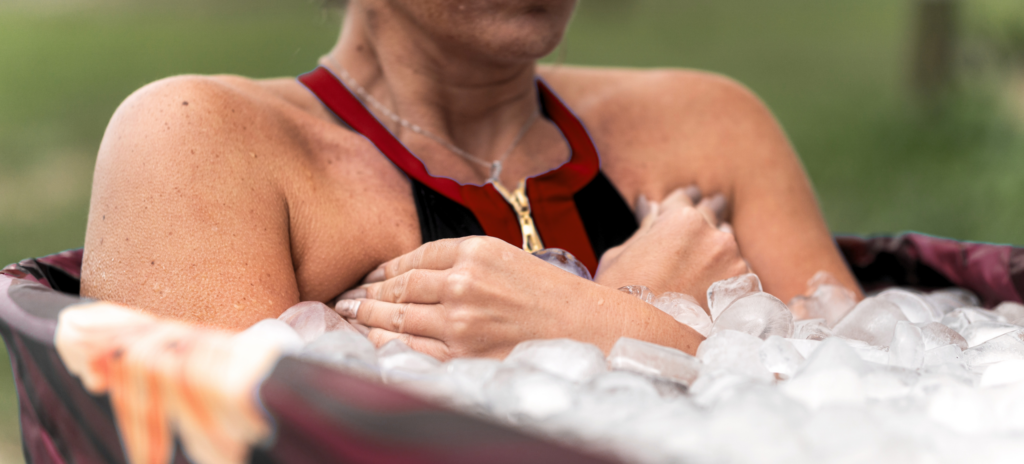
You finished a hard lift or training day. You’re sore, you’re spent, and the cold plunge in the corner of the gym is calling your name. You step in for three teeth-chattering minutes, climb out feeling reborn, and tell yourself you just earned an edge.
Here’s the inconvenient truth: if your goal that day was to build muscle, you may have just blunted the very signals you spent the last hour creating.
The cold plunge is the recovery tool of the moment. Influencers swear by it. Pro teams have them. Wellness bros post about 47-degree water like it’s a personality. And the research, when you actually read it, is far more nuanced than the marketing.
The Myth: Colder = Better Recovery
The pitch is simple. Cold reduces inflammation. Inflammation causes soreness. Less soreness means faster recovery. Faster recovery means more training. More training means more gains. The math sounds airtight.
The problem is in the second step. Inflammation isn’t just a side effect of training — for strength training specifically, it’s a required part of the adaptation process. Your muscle gets stronger because of the cascade of inflammatory and anabolic signals that follow a hard set. Suppress those signals at the wrong moment, and you suppress the adaptation itself.
That’s not a hot take from a contrarian. That’s the consensus emerging from a decade of well-designed research.
The Science: What the Cold Actually Does to a Lifting Muscle
In 2015, a landmark trial in the Journal of Physiology had subjects strength train for 12 weeks. One group did 10 minutes of post-workout cold water immersion. The other did light active recovery on a bike. Both groups lifted the same program. Both ate similarly. The result at the end of 12 weeks: the active recovery group built significantly more muscle mass and gained more strength than the cold plunge group.
That study kicked off a wave of research, and the picture has only gotten sharper. A 2019 trial in the Journal of Applied Physiology showed that post-exercise cold immersion blunted key anabolic signaling pathways — including mTORC1 activation, ribosome biogenesis, and satellite cell activity — for hours after a workout. A separate 2019 study published in the American Journal of Physiology found that when subjects drank a protein shake after lifting, the cooled leg incorporated significantly fewer of those amino acids into new muscle protein than the non-cooled leg over the next five hours. The shake was identical. The cold leg simply couldn’t use it as well.
A 2024 meta-analysis in the European Journal of Sport Science — bluntly titled “Throwing cold water on muscle growth” — pooled the data across studies and reached a clear conclusion: post-resistance-training cold water immersion meaningfully attenuates muscle hypertrophy, even when one-rep max strength stays roughly comparable. You may keep your top-end numbers. You’ll just have less muscle underneath them.
So Cold Plunging Is Useless? Not Quite.
Here’s where the conversation usually goes off the rails. The same research that flags the hypertrophy problem also shows real, replicable benefits in the right context.
A 2025 network meta-analysis in Frontiers in Physiology, pooling 55 randomized controlled trials, found that 10–15 minute immersions in 11–15°C (52–59°F) water meaningfully reduced delayed-onset muscle soreness compared to passive recovery. That matters when you have to perform again the next day — a tournament, a race weekend, two-a-days during preseason, a doubleheader. Reducing soreness lets you show up sharper for the second session.
The signal across the literature is consistent: cold water immersion is genuinely useful for short-term performance recovery and managing soreness during dense competition windows. It just isn’t a tool you want stacked on top of every strength workout if your goal is to grow.
The Practical Framework: When to Plunge, When to Skip
The right answer isn’t “always” or “never.” It’s strategic. Here’s how to think about it:
Skip the plunge when:
- You just finished a hypertrophy-focused strength session, and your goal is muscle growth
- You’re in an off-season or build phase where long-term adaptation matters more than next-day freshness
- The workout you just finished is the primary stimulus you’re trying to grow from
Reach for the plunge when:
- You have a competition, game, or hard session within the next 24 hours and need to dampen soreness
- You’re deep into an in-season block where performing tomorrow matters more than maximum adaptation
- You’re using it for general wellness, mood, or stress regulation — not as a post-lift recovery tool
- You finished a long endurance session and have to train again early the next morning
If you must plunge after lifting, time it right. The blunting effect on muscle growth is most pronounced when cold immersion happens immediately after the workout. If you lift in the morning and plunge eight hours later, the impact on hypertrophy signaling is significantly smaller. A simple rule of thumb: separate the cold from the lift by at least four to six hours when you can.
Mind the dose. The research on soreness reduction converges in roughly 10–15 minutes in 50–59°F water. You don’t need 38°F. You don’t need 20 minutes. Going colder and longer doesn’t add benefit — it just adds risk of cold-injury, blood pressure spikes, and afterdrop.
Match the tool to the day. A heavy squat day demands different recovery than a 10K race or a soccer tournament. Treat your cold plunge like a medication, not a multivitamin: the right dose, on the right day, for the right reason.
The Bottom Line
The cold plunge is neither a miracle nor a scam. It’s a tool with a specific, narrow job — and most people are using it for the wrong job at the wrong time.
If your priority is building muscle, the smartest thing you can do after a hard lift is feed your body, hydrate, sleep, and let the inflammatory and anabolic signals do their work. Save the cold for the days when you need to perform tomorrow — not the days you’re trying to grow.
The athletes getting the most out of cold exposure in 2026 aren’t the ones plunging every day. They’re the ones who know when not to.
Need Help Now?
At R3 Athletic & Physical Therapy, we specialize in helping active individuals recover faster and stay injury-free—without relying on medications or surgery.
We offer a FREE Discovery Visit to help you figure out what’s going on, why it’s happening, and what you can do about it.
 Book your free visit today and take the first step toward a pain-free future.