This is one of the most common things we hear at R3 Athletic and Physical Therapy in Milpitas, CA. A runner, a lifter, a CrossFit athlete, or a 52-year-old trying to get back into hiking comes in and tells us they stretch every morning, every night, sometimes both. They’ve been doing it for years. Their hamstrings are still tight. Their hips still won’t open up. Their overhead position still looks like they’d have trouble putting a t-shirt on.
The stretching isn’t working. And the reason isn’t that they need to stretch more. The reason is that passive stretching, by itself, does not build the kind of mobility that your body will actually use.
What Passive Stretching Does (And Doesn't Do)
When you hold a static stretch, a few things happen. The muscle lengthens under mild tension. You feel a pull. Over a few minutes, the nervous system downregulates that sensation and the pull becomes more tolerable. You feel looser. You stand up, move around, and within 20 to 30 minutes your range of motion looks almost identical to where it started.
Passive stretching creates a temporary change in how your nervous system perceives that range of motion. It does not create a structural change in the tissue. Muscles do not permanently lengthen from sustained holds the way a taffy candy stretches. What you’re actually doing is convincing your brain, briefly, that it’s okay to access that range. The moment you stop, the conversation resets.
This is why people who stretch religiously for months or years still feel tight. The tissue isn’t the real limiting factor. The nervous system is.
Why Your Nervous System Restricts Your Range of Motion
Your brain has one job that overrides everything else: keep you from getting hurt. When you move into a range of motion where you don’t have muscular control, your nervous system treats that as dangerous territory. It responds by tightening up, limiting access, and essentially putting a fence around any joint position where you can’t produce force.
This is not a flaw. It’s a protection mechanism. If you’re going into end-range hip flexion and you have no muscular ability to control or escape that position, your brain will not let you go there freely. The restriction you interpret as tightness is often just your body enforcing a safety rule.
The implication is significant. If you want your nervous system to give you access to more range of motion, you don’t just need to be in that range. You need to demonstrate that you can produce force and control movement while you’re there. The fence comes down when you can show the nervous system that you know what you’re doing in that territory.
What End Range Strengthening Actually Means
End range strengthening means training your muscles specifically in the lengthened, outer position of a joint’s range of motion. Instead of using stretching to passively access that range, you use your surrounding musculature to ACTIVELY reach it.
A simple example: instead of holding a deep hip flexor stretch and waiting, you hold that position and then actively contract the hip flexor as hard as you can against an immovable resistance for 10 to 20 seconds, then immediately contract the opposing musculature pulling in the other direction.
What you’re doing neurologically is sending the brain a clear signal: I can produce force here. I am not helpless at this range. The brain responds by relaxing its protective restriction and allowing you to access that range more freely, and more durably than any passive hold will provide.
What This Looks Like in Practice
For a runner with limited hip extension, passive stretching of the hip flexor might feel productive but doesn’t transfer to gait. End range work looks different: getting into a deep lunge position and actively pushing the back knee into the floor (isometric hip flexor contraction at end range), then immediately driving the hip upward against resistance (isometric hip extension). The range you earn through that contraction sequence tends to stick because it’s neurologically linked to motor control, not just a temporary reduction in perceived tension.
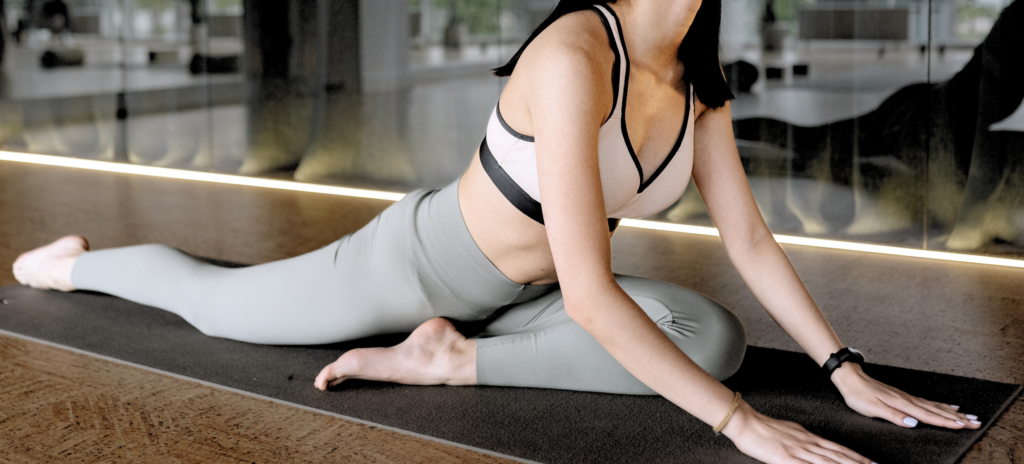
For a lifter who can’t get depth in a squat, the answer is rarely more pigeon pose. It’s usually isometric loading at the bottom of the squat, controlled descent drills, and targeted strengthening of the hip external rotators and adductors in positions they don’t normally get trained. The squat gets deeper not because the hips got looser but because the body stopped restricting a range it can now safely control.
For overhead athletes, swimmers, and CrossFit athletes dealing with shoulder mobility restrictions, the same principle applies. Passive sleeper stretches do very little for athletes who lack rotator cuff strength and scapular control at end range. Loading the shoulder through full elevation with appropriate resistance, and training the muscles that decelerate and stabilize movement at the top of the range, tends to unlock what months of static stretching couldn’t.
Why This Matters for Athletes Specifically
Passive flexibility in the absence of strength is not an athletic asset. A hypermobile joint that can’t be controlled is an injury waiting to happen. What athletes need is not more range, it’s more usable range: positions they can get into, apply force from, and get back out of safely under load and speed.
This is a distinction that comes up constantly at R3 Athletic and Physical Therapy with the athletes we work with across the Bay Area, whether they’re masters runners trying to stay durable for another decade of racing, competitive lifters chasing better positioning, or high school athletes trying to stay healthy through a long season. Mobility without strength at end range is a misleading measurement. Mobility with strength is a performance tool.
The goal of a good mobility program is not to make you look flexible on a mat. It’s to expand the range of motion you can actually use when it counts, under load, at speed, in positions your sport puts you in.
How to Start Building Real Mobility
The shift from passive stretching to end range training isn’t complicated, but it does require intentional progression. You start by identifying the specific ranges of motion that are limiting your movement or contributing to your symptoms, then work systematically to load the muscles in those positions before trying to expand them further.
A physical therapist who understands movement and strength training is genuinely useful here, not because the exercises are technically difficult, but because the sequencing matters and because pain and restriction can mean several different things. What looks like a hip flexor mobility problem might actually be a hip capsule restriction, or a motor control issue, or a strength deficit in a completely different muscle group that’s protecting an irritated structure. Getting that wrong costs time and potentially further injury.
If you’re in the South Bay or greater Bay Area and you’re tired of stretching religiously without seeing results, we’d love to talk. Our free discovery sessions is a 45-minute conversation with a clinician who can hear what you’re dealing with, give you a straight answer about what might be driving it, and tell you whether what we do is the right fit for where you’re trying to go.
R3 Athletic and Physical Therapy is a sports-focused physical therapy practice in Milpitas, CA, built around one-on-one care, hands-on treatment, and getting athletes back to and beyond the activities that actually matter to them.
Need Help Now?
At R3 Athletic & Physical Therapy, we specialize in helping active individuals recover faster and stay injury-free—without relying on medications or surgery.
We offer a FREE Discovery Visit to help you figure out what’s going on, why it’s happening, and what you can do about it.
 Book your free visit today and take the first step toward a pain-free future.