Cardiologists talk about your heart. Endocrinologists talk about your hormones. Orthopedic surgeons talk about your joints. But there is a growing body of research pointing to skeletal muscle as one of the most powerful predictors of how long you live and, more importantly, how well you live. Muscle is not just the thing that helps you lift heavy objects or finish a race. It is metabolically active tissue that regulates insulin sensitivity, protects joints, supports bone density, and determines whether a fall at seventy is a minor inconvenience or a life-altering event.
If you are over forty and your training still prioritizes cardio over resistance work, this post is for you. Not because cardio is bad. It is not. But because most active adults dramatically underinvest in the one thing that compounds most reliably as they age.
What Sarcopenia Actually Is (And Why It Starts Earlier Than You Think)
Sarcopenia is the age-related loss of skeletal muscle mass and function. Most people associate it with elderly adults who look frail or struggle to get up from a chair. But the process typically begins in your thirties and accelerates after fifty if it goes unaddressed. By the time it is visually obvious, you have usually been losing ground for a decade or more.
The decline is not just aesthetic. Loss of muscle mass correlates with reduced insulin sensitivity, increased cardiovascular risk, lower bone mineral density, slower metabolism, and significantly higher injury risk. Grip strength, which is a proxy for overall muscle mass and neuromuscular function, has been used in multiple large-scale studies as a predictor of all-cause mortality. The research is not subtle. Stronger people live longer and stay functional longer.
The good news is that muscle responds to training stimulus at virtually any age. The body does not stop building muscle at fifty or sixty or seventy. It requires more deliberate stimulus and more recovery time, but the adaptation is real. This is one of the more encouraging findings to come out of exercise physiology in the last two decades.
Why Cardio Alone Is Not Enough
Zone 2 training is having a well-deserved cultural moment. Improving mitochondrial density, cardiovascular efficiency, and aerobic base are genuinely important. If you are running, cycling, swimming, or rowing regularly, that work has real value and we are not here to tell you otherwise.
But cardio training does not build meaningful amounts of muscle mass. It does not impose the mechanical load required to stimulate muscle protein synthesis at the rate needed to offset age-related loss. It does not train the neuromuscular patterns that protect you when you stumble on a trail or step off an unexpected curb. And it does not build the kind of force production capacity that keeps your joints stable under load.
The athletes and active adults who age best are typically the ones doing both. A strong aerobic base plus consistent resistance training, progressed intelligently over years. Not one or the other.
What Effective Strength Training for Longevity Actually Looks Like
This is where we need to push back on the idea that strength training for longevity means light weights and high reps to stay safe. That approach is not wrong, but it undershoots the stimulus required to actually drive meaningful muscle and strength adaptation.
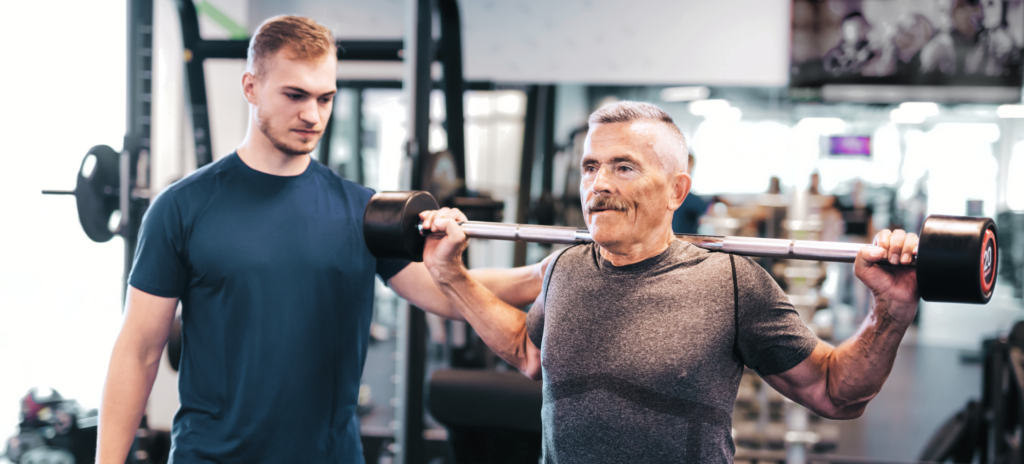
The evidence points toward a few key principles. Progressive overload matters. You need to consistently challenge your muscles beyond what they are already accustomed to, which means adding load, reps, or complexity over time. Compound movements that load large muscle groups through full ranges of motion (think squats, hip hinges, rows, and presses) deliver more stimulus per session than isolated exercises. And training frequency across the week matters as much as any single session.
For people in their fifties, sixties, and beyond, the programming also needs to account for recovery capacity, joint tolerance, and injury history. That is not a reason to train less hard. It is a reason to train more intelligently.
How Blood Flow Restriction Training Changes the Equation
One of the more useful tools for longevity-focused training, particularly for people managing joint pain, recovering from injury, or working around orthopedic limitations, is Blood Flow Restriction training, or BFR.
BFR uses a cuff or wrap applied to the proximal portion of a limb to partially restrict venous blood flow while preserving arterial flow. The result is that you can achieve significant muscle hypertrophy and strength gains at loads much lower than what traditional resistance training requires, typically 20 to 40 percent of your one-rep maximum rather than 70 to 85 percent. The metabolic stress and cellular signaling produced by BFR at low loads mirrors what you get from high-load training in terms of muscle-building response.
For a sixty-year-old with knee osteoarthritis who cannot tolerate heavy leg press, BFR allows meaningful quad development without compressing a damaged joint under high load. For someone post-surgery rebuilding atrophied tissue, BFR bridges the gap when heavy training is contraindicated. For a masters athlete managing multiple training stressors across a season, it can maintain muscle mass with lower mechanical fatigue. It is one of the more genuinely useful tools in modern rehabilitation and performance, and it is a regular part of our work with longevity-focused clients at R3 Athletic and Physical Therapy in Milpitas.
The Performance Longevity Mindset
The framing of strength training as something you do to avoid frailty does not land well with most of the people we work with. They are not thinking about frailty. They are thinking about the hiking trip they have planned for next fall. The ski season. The race calendar. The desire to still be doing the things that actually make life feel worth living at sixty-five or seventy-five or beyond.
That framing is more accurate anyway. The goal is not the absence of decline. It is the extension of genuine function, strength, and capacity well into the decades when most people quietly start doing less. Across the Bay Area, we are seeing more adults in their fifties and sixties training with intention and specificity because they understand that the window to build a strong foundation is not forever, but it is longer than most people assume.
The work you put in now compounds. The muscle you build and maintain this year is the reserve you draw from in fifteen years.
How to Get Started If You Are Not Sure Where to Begin
If you have been cardio-focused for years and are ready to add real resistance training, or if you have pain or injury that has made strength work feel inaccessible, a good first step is an assessment with a physical therapist who understands both the performance and longevity angles. Not a generic evaluation. One where someone actually looks at how you move, what your history is, and what you are trying to build toward.
We offer free discovery calls at R3 Athletic and Physical Therapy in Milpitas for exactly this reason. It is a low-stakes conversation about where you are and whether we can help. Book yours at r3athleticpt.com.
R3 Athletic and Physical Therapy is a sports-focused physical therapy practice in Milpitas, CA, offering one-on-one care, hands-on treatment, and performance-informed programming for athletes and longevity-minded adults who want to keep doing the things that matter.
Need Help Now?
At R3 Athletic & Physical Therapy, we specialize in helping active individuals recover faster and stay injury-free—without relying on medications or surgery.
We offer a FREE Discovery Visit to help you figure out what’s going on, why it’s happening, and what you can do about it.
 Book your free visit today and take the first step toward a pain-free future.