
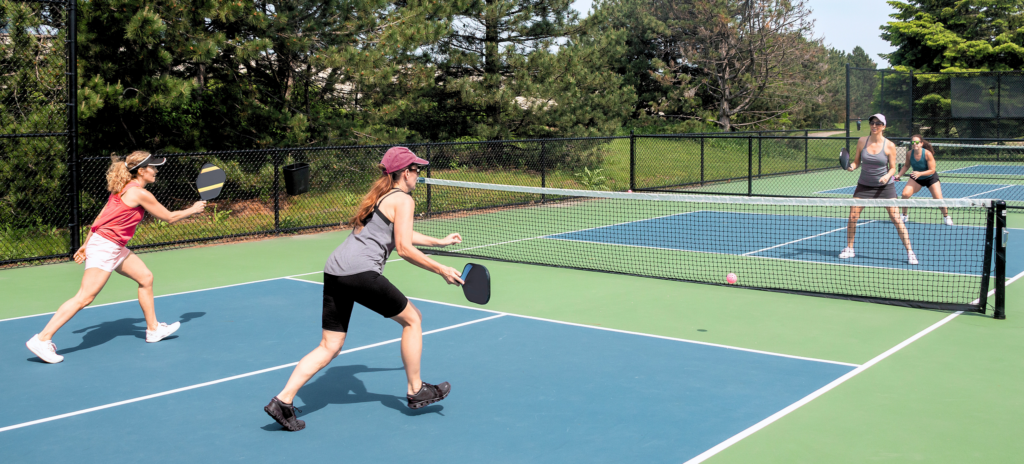
Pickleball is one of the fastest-growing sports that shows no sign of ending. Courts are packed across the Bay Area, rec leagues are full, and a not-insignificant number of people who swore they were done with competitive sports have rediscovered the feeling of winning a point. It is a genuinely fun game. It is also producing a steady stream of injuries that most players are not prepared for.
The sport is often marketed as low-impact and easy on the body, which is partially true and mostly misleading. Yes, the court is smaller than a tennis court. No, that does not mean your tendons, joints, and muscles are off the hook. If anything, the short explosive bursts, frequent direction changes, and repetitive overhead and lateral strokes create a very specific injury profile that catches a lot of players off guard, especially those returning to sport after years away from it.
Why Pickleballers Get Injured
The injury surge in pickleball is not random. It follows a predictable pattern that anyone who works in sports medicine has come to recognize quickly. The sport attracts a large population of adults in their 40s, 50s, and 60s who are enthusiastic, competitive, and playing a lot, often jumping from occasional recreational activity to five or six sessions per week because the game is that addictive.
That load spike, going from minimal athletic demand to repetitive high-frequency play in a short window, is exactly how overuse injuries happen. Tendons and joints adapt to load over time, but they need time. When someone goes from the couch to the court three days in a row, their cardiovascular system might handle it fine while their lateral elbow, rotator cuff, and Achilles tendon quietly accumulate damage they will not feel for weeks.
Add to that the biomechanical demands of the sport itself: rapid lateral shuffles that load the hip and knee, the forehand and backhand drives that create repetitive wrist and elbow stress, and the overhead smash that asks a shoulder to do something it may not have done since the Reagan administration. The body is capable of handling all of it. It just needs to be built up to it.
The Elbow: Pickleball's Most Common Casualty
If you have played pickleball for more than a few months, you have probably heard someone mention “pickleball elbow.” It is not an official diagnosis, but it describes lateral epicondylalgia well enough that the term has stuck. The extensor tendons of the forearm attach at the lateral epicondyle, the bony point on the outside of your elbow, and they take a beating from the repetitive gripping, flicking, and driving motions that define the game.
The pain tends to show up as a sharp or burning sensation on the outside of the elbow during or after play, sometimes radiating into the forearm. It worsens with grip, gets irritated by repeated wrist extension, and has a way of making ordinary tasks like opening a jar or lifting a coffee mug surprisingly unpleasant.
The good news is that lateral elbow tendinopathy responds well to targeted treatment. The bad news is that people tend to ignore it until it becomes a significant problem. A graded loading program that progressively rebuilds the capacity of the extensor tendons, combined with some attention to grip technique and paddle setup, resolves most cases. For chronic or stubborn presentations, shockwave therapy has strong evidence in this area and can accelerate the tissue response considerably.
Knee Pain: The Meniscus and the MCL
The pickleball split step, that little hop before your opponent hits the ball, followed by a rapid push-off in any direction, creates significant rotational and shear force at the knee. Meniscus irritation and medial collateral ligament (MCL) sprains are both common, particularly in players who are carrying some prior knee history, poor movement mechanics, and below average strength.
Knee injuries in pickleball often present as pain with pivoting, a sense of instability, or swelling after a session. They are frequently undertreated because the pain levels are tolerable enough that players keep going, essentially extending the timeline of the injury every time they step back on the court.
Management depends on the structure involved and the severity of the injury. Meniscal irritation in active adults often responds very well to a combination of manual therapy, targeted strengthening of the quadriceps and hip stabilizers, technique improvement, and load management. Ligamentous sprains follow a similar path. The key is not just getting the acute pain down but building the neuromuscular control around the knee so it handles the rotational demands of the game without relying on passive structures to do all the stabilizing work.
Shoulder Pain: The Overhead Problem
Pickleball requires less overhead volume than tennis or volleyball, but it requires more than most players have been doing for the past decade. The overhead smash, the high volley, and the reach for wide balls all put the rotator cuff, the biceps tendon, and the structures of the shoulder complex under repetitive stress that adds up quickly.
Rotator cuff tendinopathy and subacromial impingement are the most common presentations. Pain typically shows up at the front or outside of the shoulder during overhead motion, hard hit forehands and backhands, and sometimes waking players up at night if the irritation is significant. In athletes with longer-standing shoulder problems or those who have had a prior injury, the tissue quality of the cuff may already be compromised, which means the threshold for a symptomatic episode is lower than it would otherwise be.
Treatment involves addressing mobility deficits in the thoracic spine and shoulder, strengthening the rotator cuff and scapular muscles through full range of motion, and gradually reintroducing overhead loading. For cases where tissue degeneration is a factor, EMTT and shockwave can be useful tools in the regeneration phase, restoring the tissue quality needed to handle training load without persistent flare-ups.
The Bigger Picture: Playing More by Breaking Down Less
Here in the Bay Area, we see pickleball players across the full spectrum, from the person who just picked up a paddle last month to the competitive player. The injuries are often similar. The difference is usually how long someone waited before doing something about them and their overall tissue capacity.
The version of this story we like best is the one where someone comes in early, we identify what is loading unevenly, we address the tissue irritability, build the capacity of the structures that need it, and they go back to the court without a two-month interruption. That outcome is more common than most people expect, and it is far more common when treatment starts before the injury has been grinding for six months.
If your elbow, knee, or shoulder has been talking to you after your last few sessions, a free discovery call at r3athleticpt.com is the right first step. We will sort out what is actually going on and build a plan that keeps you on the court.
R3 Athletic & Physical Therapy is a sports-focused physical therapy practice in Milpitas, CA, specializing in one-on-one care, hands-on treatment, and regenerative therapies including shockwave and EMTT for athletes and active adults.
Need Help Now?
At R3 Athletic & Physical Therapy, we specialize in helping active individuals recover faster and stay injury-free—without relying on medications or surgery.
We offer a FREE Discovery Visit to help you figure out what’s going on, why it’s happening, and what you can do about it.
 Book your free visit today and take the first step toward a pain-free future.