
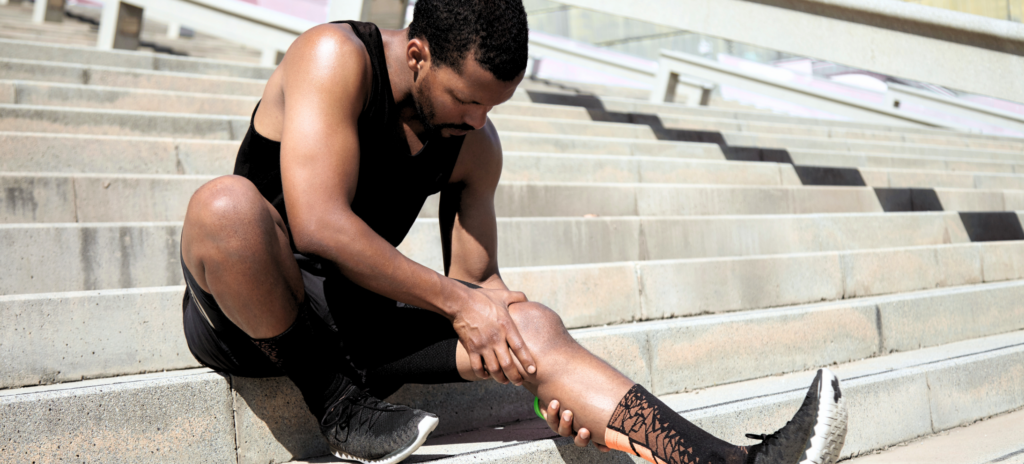
You’ve had the same nagging pain for three months. The bottom of your kneecap when you stand up from a chair. The back of your heel on your first few steps in the morning. The outside of your hip when you roll onto it at night.
You did the obvious thing. You backed off. You skipped your runs, dropped the squats, swapped the stairs for the elevator. You waited.
It’s still there.
Here’s the part nobody told you: that’s exactly what the research would predict. For the kind of pain you’re dealing with, rest isn’t a treatment. It’s the reason it isn’t getting better.
The Myth: Tendon Pain Means You Need to Rest the Tendon
This is the deepest-rooted misunderstanding in musculoskeletal medicine, and it’s the one that traps the most active people. It comes from an old assumption — that tendon pain is an “-itis,” an inflammation, a small fire inside the tendon that needs to cool down before you load it again.
That model has been quietly dying in the research literature for two decades. The condition formerly known as “tendonitis” is now called tendinopathy, and the name change isn’t cosmetic. Biopsies of painful tendons rarely show inflammatory cells. What they show is disorganized collagen, abnormal cell activity, and a matrix that has slowly drifted away from healthy structure under repetitive load.
In 2009, Cook and Purdam published the continuum model of tendon pathology in the British Journal of Sports Medicine — a paper that has shaped a generation of PT practice. Their argument, supported by every major review since, is that tendons live on a continuum from healthy to reactive to disrepair to degenerative, and the single biggest force pushing a tendon up or down that continuum is load. Too little load, and the tendon weakens and fails to repair. Too much load too fast, and the tendon overshoots its capacity and flares.
Rest sits in the “too little” column. You’re starving the tendon of the exact stimulus it needs to remodel.
The Science: Why Tendons Need Heavy, Slow Load
The principle that’s emerged over the last fifteen years is deceptively simple. Healthy tendons are built and rebuilt by mechanical tension. Stress them in the right way, and the cells inside (the tenocytes) lay down new, well-aligned collagen. Stress them in the wrong way — too fast, too sudden, too random — and the matrix gets messy.
That’s where Heavy Slow Resistance training (HSR) comes in. The protocol is exactly what it sounds like: heavy loads, lifted slowly. Three seconds up, three seconds down. Six to fifteen reps. Loads that creep into the 70–85% of one-rep max range over the first several weeks. It’s loading that looks more like a gym session than a rehab clinic.
The evidence behind this approach is strong and getting stronger. A landmark 2015 randomized trial in the American Journal of Sports Medicine by Beyer and colleagues compared HSR to traditional eccentric calf raises (the “Alfredson protocol”) in patients with chronic Achilles tendinopathy. After 12 weeks, both groups had similar pain and function improvements — but the HSR group reported significantly higher satisfaction and was meeting their treatment three times a week instead of twice a day. By 52 weeks, the outcomes had converged, but HSR had gotten there with a fraction of the time burden.
For patellar tendinopathy (“jumper’s knee”), the picture is even clearer. A 2024 randomized controlled trial published in BMC Sports Science, Medicine and Rehabilitation combined HSR with adjunct therapy and showed significant improvements in pain and function, while a 2024 network meta-analysis in Heliyon compared eccentric, isometric, and HSR protocols and found HSR producing the most favorable shift on the validated VISA-P questionnaire. The 2024 review also pointed out something important: HSR appears to drive measurable increases in tendon stiffness and structural quality, not just pain reduction.
The application has now expanded to other tendons as well. A 2025 feasibility study in Musculoskeletal Science and Practice applied HSR principles to gluteal tendinopathy (the lateral hip pain that plagues runners and middle-aged active adults) and found patients tolerated the loading well and reported meaningful improvements over 12 weeks.
The headline across all of this: tendons don’t heal because you stopped using them. They heal because you used them the right way.
The Practical Framework: How to Load a Painful Tendon
This is not a license to grit your teeth and load through anything that hurts. There’s a difference between productive load and destructive load, and the line is more specific than most people think.
A little pain during loading is okay. A flare the next day is not. The working rule from the tendinopathy research is that pain during the exercise can sit at a 3 or 4 out of 10 and remain productive. What matters more is the 24-hour response: if your morning stiffness or pain the next day is the same or better than before, you’re loading correctly. If it’s clearly worse, you went too hard.
Slow the tempo down. This is the part most people skip. A typical HSR rep takes six full seconds — three on the way up, three on the way down. Fast reps load the tendon elastically and don’t drive the same adaptation. Slow reps force the muscle and tendon to accept the load through their full range and full duration.
Train through the symptom, not around it. If your patellar tendon is the problem, you load the patellar tendon — single-leg squats, decline squats, leg press. If your Achilles is the problem, you load the calf with weight in your hands or on your back. The temptation is to “rest the painful one and train everything else.” That keeps you fit but doesn’t fix the tendon.
Two to three sessions per week is the sweet spot. Tendons remodel slowly, on the order of months, not weeks. The HSR protocols in the literature run 12 weeks minimum. You’re playing a longer game than you would with a sprained ankle or a strained muscle.
Progress the load, not the volume. The point isn’t to do more reps or longer sessions over time. It’s to add weight while keeping the same slow tempo and rep range. The tendon adapts to how heavy, not to how long.
The Bottom Line
If your tendon has been hurting for more than a few weeks and you’ve been “resting it” without a clear plan to load it again, you’re not healing. You’re decompensating, and the tendon will be weaker and more reactive when you finally come back.
The path through tendon pain isn’t around the load. It’s through the load — heavy, slow, and progressive, dosed by how the tendon responds the next morning. That’s the message every major review of the last decade has converged on, and it’s the message that keeps surprising people who walked into rehab expecting to do nothing for a while.
Tendons aren’t fragile. They’re cautious. Give them the right kind of stress, and they will quietly remodel themselves into something stronger than what you started with.
If you’ve been dealing with stubborn Achilles, knee, hip, or elbow pain that hasn’t responded to rest, the team at R3 Athletic can help you build a loading plan that actually fits your tendon’s stage and your training goals. Book a free consultation and let’s get you moving forward instead of waiting it out.
Need Help Now?
At R3 Athletic & Physical Therapy, we specialize in helping active individuals recover faster and stay injury-free—without relying on medications or surgery.
We offer a FREE Discovery Visit to help you figure out what’s going on, why it’s happening, and what you can do about it.
👉 Book your free visit today and take the first step toward a pain-free future.